Four roles sit close to a client's AI project: software engineer, solutions architect, consultant and forward deployed engineer. Ask one question to tell them apart. When the client's data is a mess and the system goes live anyway, who owns the outcome?
The FDE does. The solutions architect owns the design that won the deal. The consultant owns the recommendation. The software engineer owns the product feature every customer uses. Only the FDE answers for what happens inside one client's systems after go-live.
Why it matters to you: these four job posts often read alike. If you pick by what you want to own, you stop applying to roles you'll leave in a year.
What this post covers
- What each of the four roles is, shown through one client problem
- The one difference that matters: what you own after go-live
- The four roles side by side
- A quick test for which role fits you
- How good advisors hand work over, and what to do today
Yesterday's post covered what an FDE does all week. This one tells you whether you want that week.
One client problem, four answers
Rohan spent five years at a large IT services company. He now works at an AI startup, and his client is a mid-sized lender.
The complaints head wants AI summaries of customer complaints, using a hosted LLM.
Then the risk lead joins the call.
"No customer identifier leaves our network. Not a name, not an account number. But the summary must still say which customer it is about."
Four people respond.
- The solutions architect draws the design: redact before the call, re-insert names after. The deal closes.
- The consultant writes a data-handling policy and a vendor checklist. The risk lead signs it.
- The software engineer at the vendor builds a redaction feature for every customer's product.
- Rohan, the FDE, has to make it work on this lender's real complaints.
His senior asks one question. "Who finds the names before the call?"
"I was going to ask the LLM to redact them."
"Then you've sent it the names to find them."
So Rohan swaps the plan. The names are already in the case record, so he uses those, not a model, to mask them. Then he adds a fixed check on the exact outgoing text. If anything that looks like an identifier is still there, the call doesn't go out.
That last step, a fixed rule that blocks the request whatever the redactor missed, is the part nobody else in the room owns. It is the FDE's job.
What each role literally is:
- Software engineer (SWE): builds and maintains one product for many customers. Generality comes first.
- Solutions architect: designs how the product fits a customer's systems, usually before or around the sale.
- Consultant: diagnoses the problem and recommends what to do. Often does not write or run the code.
- Forward deployed engineer (FDE): builds and runs the system inside one customer's environment, on their data, and carries what it learns back to the product team.
The one difference: what you own after go-live
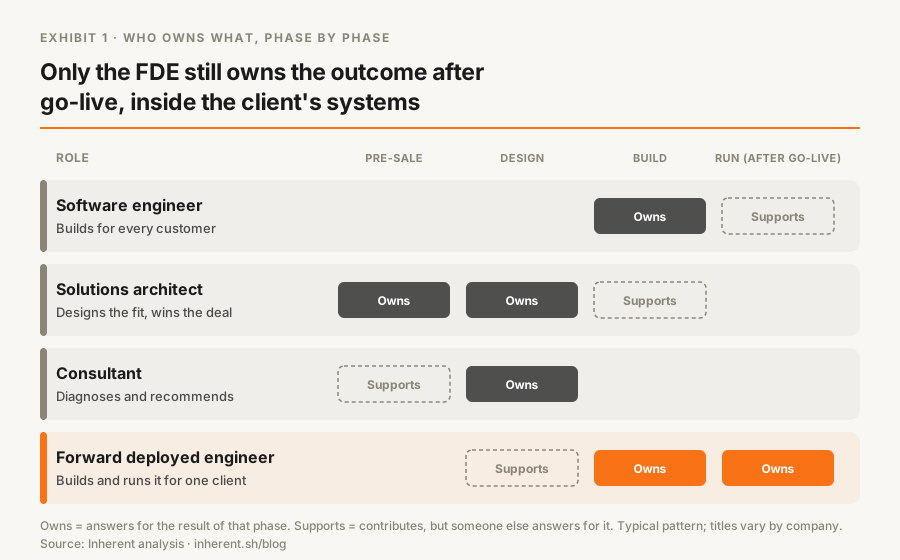
Look along the timeline of one engagement: pre-sale, design, build, run.
- The solutions architect is busiest before the contract and through design.
- The consultant owns the diagnosis and the plan.
- The SWE builds, but builds for every customer, not this one.
- The FDE builds for this client and stays on through the first weeks of running.
The run phase is where messy data shows up. It shows up as old documents, odd permissions, or a field that means two things. Whoever is there then learns the most, and gets blamed the most.
The four roles, side by side
|
SWE |
Solutions architect |
Consultant |
FDE |
| Works for |
Every customer |
The deal |
The client's decision |
One client's outcome |
| Main output |
Product code |
Reference design, proof of concept |
Recommendation, plan |
Running system on client data |
| Judged on |
Quality, velocity |
Deals won, design fit |
Client adopts the advice |
It works in their environment |
| Messy data is |
A bug report |
A risk in the proposal |
A finding |
Your Tuesday |
| Hardest skill to learn |
Scale |
Selling the design |
Getting the decision made |
Ownership with no clean spec |
Which role fits you: a quick test
Answer these with the last six months of your own work in mind:
- When a client's data broke your code, did you want to fix it yourself, or flag it to the right team?
- Do you enjoy the meeting where the deal gets won, or the week after?
- Would you rather write the plan or be on call for it?
- Do you get energy from one client's odd edge case, or from solving it once for everyone?
Mostly "fix it, week after, on call, odd edge case" points to FDE. "Flag it, solve it once" points to SWE. Loving the winning meeting points to solutions architect. Preferring to write the plan points to consulting. Mixed answers? The full assessment below scores them properly.
The full role-fit self-assessment, with twelve statements, a score sheet and what to practise for each role, is in the FDE Field Manual. Preview:
Role-fit self-assessment (preview)
- 12 statements from real client situations, scored 1 to 5
- A score sheet that maps your answers to SWE, solutions architect, consultant or FDE
- For your top role: the one skill to practise this month
Create a free Inherent account to get it.
From the field: how good advisors hand work over
A strong advisor never ends an engagement with only a slide deck. They end it with a named person on the client side who owns each next step, and a date.
The habit is worth copying whichever role you pick. Before you leave any client meeting, say out loud who owns the next action and by when. Solutions architects who do this close more cleanly. FDEs who do this leave pilots that keep running.
TL;DR
- SWE, solutions architect, consultant and FDE all touch client AI work. They own different things.
- The test question: when the client's data is a mess and the system goes live, who owns the outcome? That's the FDE.
- Solutions architects own the design and the deal. Consultants own the recommendation. SWEs own the product.
- Choose by what you want to own after go-live.
What to do today
Take the four questions above and answer them in writing. Then look at your last project. Find the moment the client's data surprised you, and note what you did next. That moment tells you more about your fit than any job post.
Then get the FDE Field Manual with a free account. It holds the full role-fit self-assessment and each playbook from this series as it ships.